ALC. 13.7% BY VOL.
Return to menu

Our Story

Why We Started Liquid Farm

Before Liquid Farm, our glasses were often filled with old world wine, rather than domestic. We preferred the lower alcohol, cooler climate, and more earth-driven characteristics of European wines to their often ripe, fruit-focused, more alcoholic Californian counterparts.

As we believe, the first bottle to disappear at your the table is really the best wine for you – period. And, for us, when we tried to support California, there was typically wine left in the bottle the next day while the old world bottles. not a drop in them, would be lined up like proud dead soldiers.

We were eating local, supporting mom and pop restaurants and farmers markets - it was time to make wine in a style we craved from our own backyard.

Our Mission

We seek to support local viticulture and honor our palates' love for old world wines that have naturally high acidity and are not masked by many of the modern day manipulations.

To do so, we selfishly decided to make what we most love to drink: Chardonnay that is earth and mineral driven from cool climates with little or no new oak. For these qualities, there was only place locally to go: one of the coolest of all California AVAs, Sta. Rita Hills. Located in Santa Barbara County, it is home to some of the most Chardonnay-suited, unique, ancient soils in North America.

From the climate and soil, to the people and their wines, Sta. Rita Hills is certainly one of the most special regions we have ever come across. We are truly honored to be a part of it.


The Name & The Label

Above Ground. Below Ground.

Is it a kohlrabi? Is it the world? Is it a beet? Here’s the story.
The name Liquid Farm was thought of long before there was wine in barrel. Our goal was to create awareness about what happens above ground and below ground, and tell the story of how both are inextricably linked to wine. Wine is, after all, a product of the earth and the human touch. It is Liquid from Farming.

In 2009, the first four barrels filled with wine and the name Liquid Farm already in place, the label itself was still a huge blank. We had a fascination with dandelions; the way they develop from pod to flower to the white fluffy thing we all made wishes on as kids. You can also make wine out of dandelions in the spring (something we have been meaning to get around to) and loved the irony that dandelion leaves and roots have been used as a tonic for wine-drenched livers for centuries.

While poking around online for botanical/Divinci-type sketches of dandelion roots we came across a black and white drawing - it appeared to be a beet root that had been mislabeled, but there was a haunting faint line running through the center that kept us coming back to it.

After a little research, we were able to track down the talented artist: Val Littlewood, a gifted nature illustrator from the UK. She was able to transform her fatefully misnamed beet root into our Liquid Farm image by adding color to the bulb, and adding in the flower (or in wine growing, the grape) that transports what is found below ground, "above ground."

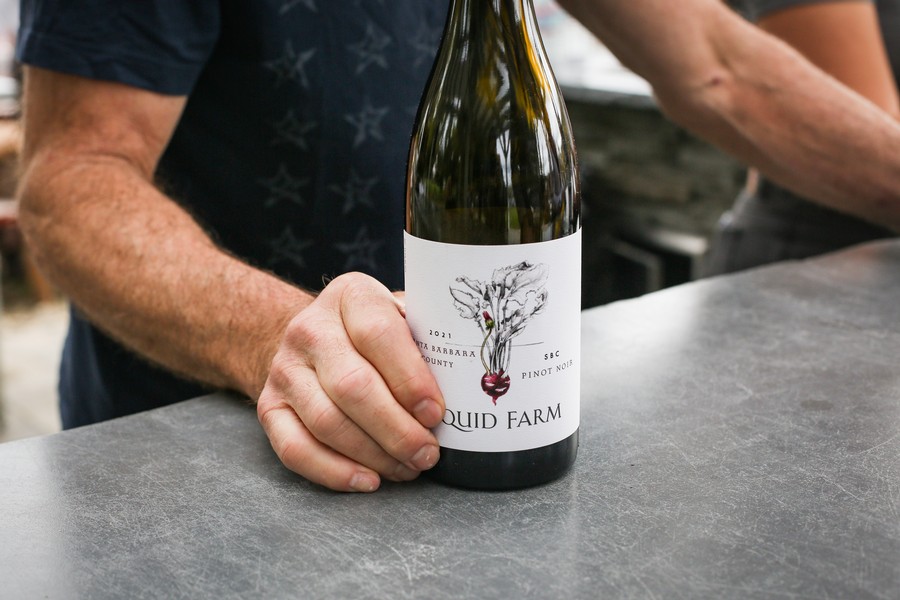
When developing the image into an actual wine label, we wanted to remain dedicated to telling the Above Ground/Below Ground story. The vintage, placed above the line, pays homage to the particular year's influence on the wine, while the AVA of Sta. Rita Hills that lies below, honors the soil’s unmistakable impact, which also ends up inside the glass.

The Team

The Nelsons

Nikki caught the food and wine bug while working in restaurants and at 22, helped open up the first fine wine shop in her hometown of Temecula, CA. Nikki went on to obtain her BA in Wine and Viticulture from Cal Poly San Luis Obispo, with a focus on Wine Business. After college, Nikki worked for one of California's great fine wine distributors, The Henry Wine Group, departing in June 2011 to release the first vintage of LF. She now runs all of the day-to-day operations, wearing a zillion hats including marketing, sales, deliveries, accounting, social media, wine club and most importantly, daily quality control of LF wines.

Jeff too started in the business directly out of college and for the past 20 years, has worked for some of the top Champagne and Burgundy houses in France, managing sales and marketing throughout Southern California. Currently he happily works for a family based in Champagne established in 1808. Jeff helps out with LF when he can in his spare time and is a constant source of direction and creative ideas for the project.

With Nikki originally based in SLO and Jeff in LA, the two finally got around to dating in 2010 after being work colleagues for two years. While on a meet in the middle date in Santa Ynez, they blurted out their first "I love you" while tasting through the 2009 barrel samples from plastic vials. They were married at Kessler-Haak Vineyard, where all of those barrel samples came from just before harvest in 2011. Vineyard owner Dan Kessler drove Nikki in on a tractor and the two made their "Just Married" getaway in the same fashion. They currently live in Los Angeles, CA with their family of feathered and furry "children": Rio, a cheese loving African Grey Parrot, Sophie, a downright human-like Labradoodle and Maya, a wine cork chasing terrier wonderdog.

Dragonette Cellars

Through various channels in the wine world, we were connected with Brandon Sparks-Gillis and John Dragonette over a decade ago. Along with Steve Dragonette and now James Sparks, the guys all followed their passions away from other work into winemaking and produced their first vintage of Dragonette Cellars in 2004. Dragonette crafts some of the most compelling wines on the Central Coast, including jaw dropping Sauvignon Blanc, small lot Pinot Noirs and Rhone reds. They are highly involved in every aspect of the vineyard-to-glass process and as mentors and friends, they could not be more incredible people to work with and know.

In 2009 before harvest, Brandon helped arrange a small amount of Chardonnay for the Liquid Farm project that was then just a twinkle of a dream, yielding the first 4 barrels of LF. The wines were, and continue to be, made with treasured guidance of the DC boys at a shared working winery in Lompoc, CA.

Winemaking Philosophy

Often said, but very true, all great wine starts in the vineyard. Our project's name reflects our strong belief in that philosophy. It is truly all about place in combination with the highest quality fruit and letting the varietal and regional TYPICITY of the wine shine through from vineyard to glass...Liquid from Farming.

We allow the wines to develop on their own with little intervention, minimal or no new oak and use no additives or machines to manipulate the wines inherent personality. The project is also committed to blending from the handful of special vineyards we work with in the small AVA of Sta. Rita Hills to produce a collection of Chardonnays that are markedly different expressions, but with the same thread of intense minerality and salinity they started with in the vineyard. Click on each Philosophy below to read more about what we do and why.

From vineyard to glass, here is what we do and why:

Expression of SRH as a Whole

Others have made outstanding single vineyard wines from this region, but our goal is to create a house style among the 3 Chardonnay bottlings by relying on the unique nuances and strengths that each vineyard brings to the table.

Wines of Modest Alcohol and Preserved Natural Acidity

Our lower alcohol content and natural acidity are due to the cool climate of SRH as well as its soils. This also means picking early and soon after phenolically ripe to lower potential alcohol and keep acidity high and pH low which equates to more balanced, table-friendly wines.

Minimal Contact in the Winery

The wine is generally left to its own devices after it is handpicked and gently pressed post-harvest. Native yeast fermentation is also carried out for all new barrels and an increasing amount of neutral barrels.

No Acidification

Winemaker’s can legally add acids to wine in the US and do so in order to balance overripe fruit. This is common in warm climates where grapes are often harvested at advanced stages of ripeness with high levels of sugars and low levels of acid.

No Manipulations

No machines or other processes are used to alter the natural color, flavor or alcohol level. This is another set of alterations surprisingly more commonly used than one would think. You can spin out alcohol, add Mega-Purple or oak chips and there are even flavor additives that can legally be used. Wine labels sadly warrant ingredient lists.

Natural ML

In the past two vintages that we can speak of, the Chardonnays have gone through 10-30% ML. We don’t force the wine through (to rev up body and creaminess) and we don’t restrain either (for forced leanness or to balance overripe fruit). It’s au naturale.

Neutral Barrels

We use 80-100% neutral oak (used min. 4-5 times and as a result don’t impart ANY aromas/flavors), as we prefer Chardonnay profiles made allowing small amounts of oxygen. Stainless tanks don’t allow oxygen at all, while heavy new/charred oak tends to mask the fruit.

DIAM Corks

The wave of the future, this cork provides the best of a natural cork (because it is!) – It’s biodegradable and breathable, but without the risk of cork taint (musty overtones) or bottle variation that occurs with uneven oxygen transfer into the wine over time.

Naked or Waxed

In an effort to lower our carbon footprint (and because it looks sexier), we use no traditional PVC capsules. Instead we leave every bottle naked/topless (no capsule at all – Go Green Go Topless!) or use a soft wax, which is a biodegradable material much like bees wax.


Wines

With only 4 barrels to start in 2009, all from the same vineyard, the original idea was to make one wine. The wine itself had a different plan and we gladly listened.

Two of the four barrels made up White Hill. With a more mineral driven profile, those barrels reminded us of drinking 1er Cru Chablis and were given their name in honor of the chalky white hills of Chablis and diatomaceous earth of Sta. Rita Hills.

The other two barrels had a profile of warmer tones and were texturally more voluptuous, reminding us of Meursault and the other sexy wines from the Cote d’ Or (Slope of Gold) we are admittingly addicted to. Hence, the two bottlings were born: White Hill and Golden Slope. In 2011 we had the opportunity to make a little Bandol-inspired Rose and since we drink white and Rose like water all year-round, it seemed like a pretty good idea.

Current Vintages

2010 'White Hill' Chardonnay

350 cases produced

AVA: Sta. Rita Hills. 
VINEYARDS: Zotovich, Kessler-Haak & Rita's Crown.
AGING: 10 months 100% Neutral.

The leaner and more Chablisiane of our two Chardonnay bottlings, White Hill highlights the unique salinity that comes through in the ancient soils of Sta. Rita Hills. The style of this wine will always be racier and 100% neutral barrel fermentation.

PROFILE: mineral. lemon curd. ginger. pear skin. tamarind. fresh citrus

$38


2010 'Golden Slope' Chardonnay

250 cases produced

AVA: Sta. Rita Hills
VINEYARDS: Zotovich & Rita's Crown
AGING: 14 mos. 82% Neutral. 18% New w/ Native Yeast Fermentation. Bottled Unfined & Unfiltered

The richer of the two bottlings, with a small amount of new barrel to add warmer tones and a more voluptuous texture, all the while still maintaining restraint.

PROFILE: hazelnut. mineral. cardamom. lemon cake. poached pear. crème friache.

$50


2011 Rosé

100 cases produced

AVA: Happy Canyon.
VINEYARDS: Vogelzang.
AGING: Neutral fermentation.

Initiated by the copious amounts of Rosé we go though at our house 10 months out of the year, the opportunity arose to make a few barrels of Bandol-inspired Rosé in a lean, mineral driven style we love from the pinks out of Provence right in our own backyard – how could we say no?

PROFILE: Minerality. Juniper Berry. Purple Basil. Blood Orange. Pomegranate

$24

NOTE: The Rosé is a very limited production. It will first be offered to Wine Club members. Join our mailing list (or wine club) for more information.


Future Vintages

2011 Four Chardonnay

By 2010, we had added two vineyards to 2009's Kessler-Haak: Zotovich Family and Rita's Crown. 2011 brought the addition of FOUR more vineyards: Bent Rock, Radian, Huber and Clos Pepe. In that same vintage we decided to create a small lot cuvee from FOUR top barrels in honor of our teeny FOUR barrel start in 2009. As we came to see, there is a bit of an organic pattern with the number FOUR throughout our project. Oddly enough, it has been both of our favorite numbers since childhood; thus, the wine sort of named itself.

NOTE: The Four Chardonnay is a very limited production. It will first be offered to Wine Club members. Join our mailing list (or wine club) for more information.


Past Vintages

White Hill 2009 (SOLD OUT)

100% Kessler-Haak Vineyard Sta. Rita Hills AVA l Alc. 13.3% l 48cs produced l 100% neutral barrel for 14mos.


Golden Slope 2009 (SOLD OUT)

100% Kessler-Haak Vineyard Sta. Rita Hills AVA l Alc. 13.3% l 48cs produced l 100% neutral barrel for 14mos.


Welcome to the LIQUID MARKET

AVAILABILITY

Our mantra is simple: quality over quantity. As a Chardonnay-focused project, hopelessly devoted to a teeny tiny AVA, our production is limited. 

To help us best allocate our production and handle the recent increase in demand from outside CA, we currently make direct consumer sales to members of our Wine Club. 

We would love for you to join us. Here is how:

IN A NUTSHELL

We offer a three-tier wine membership program that, in addition to the benefits outlined below, ensures you have enough LF for your dinner table and at the best possible price. We ship to our wine club twice a year- in spring and fall.

Members also have exclusive pre-release LIQUID MARKET access to view any additional wine that is available beyond the Club allotment. Requests will be fulfilled to the best of our abilities. Our goal is to continue to increase the amount of cases we offer to our Club as we slowly and organically grow our project.

Contact nikki@liquidfarm.com for wine club availability or with any questions.

Member benefits include:

4 Bottle Membership 6 Bottle Membership 12 Bottle Membership
Bottles per shipment 4 6 12
Bottles Per year 8 12 24
Discount on wines in each shipment 10% 15% 20%
Complimentary shipping No ($12 CA) No ($12 CA) Yes, CA
Access to additional wines while available Yes Yes Yes
Shipping for additional wine order (non-club shipments) $12 flat rate $12 flat rate $12 flat rate
Complimentary tasting for four at the winery* Yes Yes Yes
Invitation to seasonal barrel tastings $12 flat rate $12 flat rate $12 flat rate
Intern Invites - bottling/waxing/harvest Yes Yes Yes
Private barrel tastings (up to 6)* No No Yes
Heads up on exclusive tastings and limited wine dinners Yes Yes Yes

*Tastings are at the winery by reservation only. A reservation at least two weeks in advance is appreciated.

Find Us

LF wines are available direct from the winery through our wine club. For detailed information regarding pricing, Wine Club benefits and allocation, click here. If you have trouble finding LF in your local wine shop we can point you in the right direction, just email Nikki@LiquidFarm.com

To stay in the LF loop and be contacted prior to the release of our next vintage join our mailing list. For up to date news on tastings and events, follow us on Facebook and Twitter

We are honored to have Liquid Farm available at the following fine restaurants.

San Diego

3rd Corner Wine Shop & Bistro, San Diego & Palm Desert
Flavor Del Mar, Del Mar
Gaberdine, Point Loma
The Fishery, San Diego

Orange County

Marche Moderne, Costa Mesa
Old Vine Café, Costa Mesa
The Wine Gallery, Corona del Mar

Los Angeles

AKA Bistro, Pasadena
Akasha, Culver City
BarBrix, Silverlake
Bouchon, Beverly Hills
Buzz, DT Los Angeles
Cooks County, Los Angeles
Covell Wine Bar, Los Feliz
Craft, Los Angeles
CUT, Beverly Hills
Eveleigh, West Hollywood
Hatfield's, Hollywood
Hotel Bel-Air, Wolfgang Puck, Los Angeles
JAR, Los Angeles
Left Coast Wine Bar, Glendale
Lobster, Santa Monica Left Coast Wine Bar, Glendale
Lucques, West Hollywood
Margarita Pizza Bar, Los Angeles
Mastros Steakhouse, Beverly Hills
Providence, Los Angeles
Ray's @ LACMA
Red Medicine, Beverly Hills
Salt's Cure, West Hollywood
Spago, Beverly Hills
Sunset Marquis, West Hollywood
Akasha, Culver City
Fig, Fairmont Hotel, Santa Monica
Joes, Venice
One Pico - Shutters On The Beach, Santa Monica
Primitivo, Venice
Providence, Los Angeles
Tavern, Brentwood
Westside Tavern, West Los Angeles Tar & Rosés, Santa Monica

Central Coast

15c Wine Shop & Bar, Templeton
Andelina’s Bistro, Nipomo
Los Olivos Café, Los Olivos
Lido at The Dolphin Bay, Pismo Beach
Granada Bistro, San Luis Obispo
Cecco, Solvang
Petite Valentien, Santa Barbara
Wine Cask, Santa Barbara
Tastes of the Valley Wine Bar, Solvang & Pismo Beach
CioPinot, San Luis Obispo
Gather Wine Bar, Arroyo Grande

San Francisco

RN74 – SOMA
The Barrel Room

Wholesale

For most of CA we are winery direct, email Nikki@LiquidFarm.com for inquiries. For San Diego County, contact our broker Next Generation Wines.

Outside of California

Georgia - Prime Wine & Spirits
For up to date information, join our mailing list or email us Nikki@LiquidFarm.com

Mailing List

Join our mailing list to be notified of LF news, such as the release of our next vintage and tastings and events in your area.

Wine Club Interest
Email Format

Grass Roots Press

Richard Jennings, Huffington Post, writer

April 2012, Review of the Sta. Rita Hills AVA and some its producers of note. LF wines reviewed 91-92+pts.

Phillip Carpenter, Santa Barbara Wine Talk

Lompoc Locals Day 2012.

Rob Harpest, Sommelier of Hotel Bel Air,

Blog: Late Night with a Working Sommelier, "Duo of Domestic Rosés."

Santa Ynez Valley Wine Club, Wine of the Week

Sommelier, Jon McDaniel names 2011 LF Rosé Wine of the Week.

Daily Wine Dispatch.com, Chardonnay Blind Tasting - LF #1 Wine

LF ranked #1 in Wine in Blind Chardonnay tasting among an admittedly anti-Chardonnay group.

Tasting Room radio show with Tom Leykis

Liquid Farm segment starts around :50.

Insanely Cute Wine People

Hip Tastes, Courtney Cochran, Your Personal Sommelier.

Liquid Farm "White Hill" Chardonnay 2010 & Comté

The Cheese Store of Beverly Hills Weekly Paring.

2010 White Hill Ranked #4

Red Carpet Wine Top 100.

Late Night With a Working Sommelier

Blog by Rob Harpest, Sommelier, The Hotel Bel-Air.

Life On The Liquid Farm

Santa Barbara Independent Magazine.

Nikki & Jeff on an episode of The Wine Down on THELIP.TV

03:19 Tell us about Liquid Farm.
04:24 Tell us about the Burgundian qualities and Chablis style and why that's important.
08:05 What is your case production?
09:35 Growing in Santa Rita Hills: diatomaceous earth.
11:45 Where can we buy Liquid Farm?
45:45 What is diam?

Map

Click On The Map To View A Larger Image

Vineyard Partners

Chardonnay in California within a Region 1 climate combined with the type of soils we were after is found only in a few rare pockets of the state. This makes access to such fruit more than hard to come by. Not to forget the glaring fact that only about 18% of Santa Rita Hills is planted to Chardonnay. We could not be more proud and honored to be making Chardonnay from these seven esteemed vineyards. The quality of the fruit, farming and people are second to none.  Please check out and support wines made from and by the following folks; you will not be disappointed.

Kessler-Haak

Organically farmed, this is where Jeff and I started the project in 2009 and were later married on 9-10-11. The Kessler’s, whose passions brought them to SRH in 2005, were kind enough to lend the rows of LF sourced vines as our aisle and Dan towed me in on his tractor. Producing Pinot, Chardonnay and Syrah as well as a beautiful Rosé of Pinot Noir and a little bit of old vine Riesling, they live on the land with their Moluccan Cockatoo named Einstein and few vineyard-loving Labradors. (Sandy Loam Soils / Clone 96)

Zotovich

An almost beach-sandy vineyard, Zotovich is located in the middle of Northern Santa Rita Hills on the 246 corridor, between Foley and Melville. Winemaker and Viticulturist Ryan Zotovich and his wife Brit became friends while were in the Wine & Vit program during my time at Cal Poly. This makes working with their stellar fruit even more special. Small lot Chardonnay, Pinot Noir and Syrah with an acre of Viognier and Grenache in training; check them out at their new tasting room in the Lompoc Wine Ghetto. (Sandy Loam Soils / Clone 76)

Rita’s Crown

Rita's Crown is located in the geographic center of the AVA at an elevation between 600' and 950' making it one of the highest planted vineyards in the AVA. Hence, the name “Rita's Crown” - the top or crown of the Santa Rita Hills. The site is a very powerful one that grows grapes that create wine with serious ageability and structure. Lots of lemon curd and delicious nerviness. (Sandy Clay Loam Soil / Clone 76, 95, 96 & 124)

Radian

Radian is the standard unit of angular measure, derived from the ratio between the length of an arc and its radius. Located on in the most Southwesterly corner of the AVA. The soils here are particularly loaded with Diatomaceous earth – aka; pure mineral in the form of Silica – lending piercing acidity and minerality in the resulting wines. Super low yields, but highly intense and nervy fruit that we love. (Tierra Loam Soil / Clones 76 & 95)

Bentrock

Bentrock is the result of a collision between the North American and Pacific tectonic plates, which took place some 12 to 20 million years ago in the Miocene Epoch. The yielding fruit is lean and mean, making for beautifully concentrated wines. Both Bent Rock and Radian are newer sites to come online in SRH and certainly names to watch. Formerly both vineyards were known as Salsipuedes. (Sandy Loam Soils / Clones 76 & 96)

Clos Pepe

Renowned for its legendary farming and winemaking, Wes Hagen and Steve Pepe have helped put Sta. Rita Hills on the map – literally! – Wes spearheaded the AVA’s creation and approval in 2001. The vineyard was established in 1994 and the Clos Pepe wines and fruit have been highly sought after for many years since. Wes is a wealth of knowledge about all that is Santa Rita Hills and his passion for grape growing, winemaking and virtually all topics of philosophy, history and delicious things, is certainly inspiring. Wes, Steve and their better halves live on the land, fully equipped with a herd of sheep and working dogs. (Elder Sandy Loam – Clone; 76 & Wente)

Huber

Norman and Traudl Huber planted after the Babcock’s back in the 80s, making their Chardonnay the 3rd oldest planting in the entire AVA. The older vines and ultra sandy soils lend to deeply intense flavors. They also happen to have the first and only planting of the German native varietal Dornfelder on their property. They reside on the land with their cat Blackie who is a close buddy to their Australian Shepard, Heidi. Plus, they grow some of the best apples we've ever tasted. Producing Chardonnay, Pinot Noir and Dornfelder, the latter in the form of dry wine, a dessert wine and homemade jam. (Sandy Soils / Clone 76)

For more information on the area, check out SRH Winegrowers Alliance

Soils

Derived from fossilized sea life and transported as alluvium, Santa Rita Hills’ soils are similar to those found in Champagne, Chablis and the Cote D’or. These soils are essential for the age-worthy and stunning Chardonnay that comes from each of these regions. While Calcium via chalk and limestone supplies the minerality that shines through in France, it is Calcium Silicate (aka; Silica) by way of Diatomaceous Earth that does the trick here. Diatomaceous earth, the parent material for the major soil types within the Sta. Rita Hills AVA, is made up of Diatoms (the skeletons of ancient sea creatures). Combined with the alluvial nature of these ancient Sandy Loam soils, SRH provides the perfect storm for acid-retaining, mineral-rich Chardonnay.


SANDY LOAM

SANDY Loam soil is composed of approximatley 60% sand, 15% silt, and 15% clay. These soils retain the optimal amount of water and plant essential nutrients, also allowing for rapid internal soil water movement. The combination of different Sandy Loam soil types in the SRH AVA is ideal for growing grapes of excellent quality.
en.wikipedia.org/wiki/Sand


LOAM

Loam soil, dubbed the quintessential and ideal soil, is composed of roughly 40% sand soil, 40% silt soil and 20% clay soil. Loam tends to be a courser soil. Loam soil with more clay is called clay loam soil and loam soil with more sand is called sand loam soil. The combination of different soil types creates an excellent soil for cultivation. Loam soil ideally, due to the clay percentage, retains just the right amount of water and nutrients, and due to the sand percentage, drains the right amount of water—making loam soil one of the easiest soils with which to work.
en.wikipedia.org/wiki/Loam

DIATOMACEOUS EARTH

Diatomaceous earth (i.e., fossil marine skeletons) is readily available as the soil parent material throughout the SRH. Composed of white porous rock high in Calcium Silicate (aka; Silica) a mineral with higher porosity than both chalk or limestone. In conjunction with the cool coastal climate within the SRH AVA, grapes grown in this environment exhibit soil minerality in the wine that we can actually taste. Wikipedia Natural News

Santa Rita Hills AVA soils-related text edited by:
Thomas J. Rice, Ph.D., C.P.S.S.
Certified Professional Soil Scientist No. 1932
915 Turtle Creek Dr.
Paso Robles, CA 93446
Cell: (805) 712-2880
e-mail: trice@calpoly.edu
URL: http://www.pasoterroir.com


CREDITS & WINE NERD Edu.

PEOPLE WE DIG.

Here is a partial and growing list of people and things we are particularly grateful for (not already mentioned within the site) that we would publicly like to thank.

Val Littlewood

The LF image and identity all started with a sketch of a beetroot that Val crafted and the rest is history. Val resides in her home country of England with her husband and is most passionate about bees. She really likes wine too. http://pencilandleaf.blogspot.com/

Janet Allinger

Amazing beyond belief graphic designer, illustrator and artist. Janet just plain rocks, she crafted up the Rosé label which was inspired by a bottle of 1919 Graves we enjoyed with another one of our favorite people, Erik. http://www.janetallinger.com/

Erik Kelley, The Cheese Store of Beverly Hills

Erik cooked for almost 100 people at our wedding and is a walking encyclopedia of anything and everything to do with wine and food – including of course, cheese. What’s not to love? Our African Gray loves visits from Uncle Erik as it means a Comte Rx refill. http://www.cheesestorebh.com/

Jon McDaniel

The Sommelier and Wine Director at Los Olivos Café, Jon was an LF believer from the start. He writes sassy and candid blogs via the Santa Ynez Valley Wine Club site, produces his own wine under the Amos Cellars label and is a wine personality that everyone should know. http://amoscellars.com/ http://www.facebook.com/#!/mcvino

Jeremy & Michelle Ball, Bottle Branding

This Lompoc dynamic duo is poised to possibly take over the world. Seriously. Jeremy has epic photography skills (lucky for us there are some shots that grace this site) and he dares to dream big with his lovely wife Michelle who is an equally talented artist and graphic designer. Amazing chefs, creative masterminds, great friends – “What aren’t they good at?” is perhaps the suitable question. http://www.bottlebranding.com/

Bob Dickey

Bob and his wife Deb are ultra-charming and based on the Central Coast where they work hard and play hard. Bob takes brilliant photos as well and captures many of the local wine events in Santa Barbara County. winecountrypics.com

Phil Carpenter, Santa Barbara Wine Talk & Michael Tou, Central Coast Uncorked

Two guys who are so obsessed with Central Coast wine that they have dedicated countless hours to promoting the area and it’s people – all while holding down full time day jobs NOT in the wine industry. Thank you both for your incredible enthusiasm and support! santabarbarawinetalk.com centralcoastuncorked.blogspot.com

VENDORS WE DIG.

DIAM
Corks. diam-cork.com

CalWax
You guessed it, Wax. calwax.com

Trilogy
Glass. trilogyglass.net

Landmark Label
Labels and printing. landmarklabel.com

NERD OUT

This section is dedicated to wine education, articles and blogs. Basically, stuff we dig and thought you might, too.

Link Love

The Society of Wine Educators
societyofwineeducators.org

Helpful Wine Glossary from Karen MacNeil, Author of The Wine Bible
wineanswers.com

How to taste Wine Like a Pro by Tim Gaiser, Master Sommelier
timgaiser.com

Great unpretentious Wine Basics from Lisa Dinsmore of Daily Wine Dispatch
dailywinedispatch.com

Richard Sanford, on history of SRH and being a true pioneer
thelip.tv

Indie Online TV Show featuring various personalities in the Wine Industry chatting on topics in a casual and unpretentious way
thelip.tv

Winemaking

Descriptions and Causes of Wine Faults and Flaws
bcawa.ca

Info on the Use of Sulphur Dioxide (SO2) in Winemaking
bcawa.ca

Basic Info on Malolactic Fermentation (ML)
bcawa.ca

Info on Various Acids in Winemaking
bcawa.ca

Tasting Resources

WSET Tasting Notes (pdf)
wsetglobal.com

WSET Tasting Sheet Key (pdf)
wineroute.be

Tasting Documents and other resources from the Oxford Blind Tasting Society
users.ox.ac.uk

Another type of Wine Assessment Card
bcawa.ca

Farming and Soils

Organic vs. Non-Organic Farming: The Growing Debate
enologyinternational.com

Moon Gardening Calendar / Today's Moon (UK)
the-gardeners-calendar.co.uk

A breakdown of Fruit, Leaf, Flower & Root days
lunarorganics.com

Do Fruit and Root Days really affect the way a wine tastes?
winemadenaturally.blogspot.com

How Diatomaceous Earth Works For Humans and Pets
earthworkshealth.com

Semi debunking Native Yeast Fermentation
vinography.com

Nerd out on Vineyard Site Evaluation and The Winkler Scale of Growing Degree Days. East Coast focused but overall some great material.
iagt.org

Winkler Scale of Growing Degree Days which determines an AVA’s Region #.
wikipedia.org

Stellar site on Natural Wine and “that crazy French woman” who has rallied around it in a big way

thatcrazyfrenchwoman.com

SIP Certification Official Site
sipcertified.org

Tasting Minerality

THE CHECKLIST

Back in 2006 at a Cal Poly lecture given by Keith Patterson, PhD, the great Viticulture professor-now-friend covered climate and a little thing called the Winkler Scale of Growing Degree Days. In that class I learned that Region I, with up to and including 2,500 Degree Days (Ok, I did have to Google the exact # of days, sorry Patterson!) is the coolest possible wine-growing climate, similar to regions like Champagne and Burgundy. Optimal grape varietals for Region I’s include Chardonnay, Sauvignon Blanc, Riesling and Pinot Noir. The entirety of the Sta. Rita Hills AVA falls within (and sometimes below!) this chilly Region 1 due to the marine influence that the unique East-to-West mountain range allows, creating a trough for cool air funnels through like a champ. Cool climates make for grapes with naturally high acidity, lower potential alcohol when picked soon after phenolically ripe, and produce Chardonnay that exhibits the left scale of the following varietal markers and characteristics:

COOL CLIMATE:  MODERATE CLIMATE: WARM CLIMATE:
Region 1  Region 2 & 3 Region 4 & 5
Sta. Rita Hills/Chablis Bordeaux/Rhone Southern Spain/ East Paso Robles
apple, pear stone fruits tropical fruits
Earth w/ pure fruit Pure Fruit Candied fruit
 High acidity Moderate Acidity Low Acidity
Lowest Alc. Moderate Alc. Higher Alc.
Great minerality potential Little minerality No minerality

What you get on the far left is what we’re addicted to in wines from Region 1's like Burgundy and other über-cool climates such as the Loire Valley, Northern Italy and North Western Spain. So, step 1, Cool climate – check! But, as studies are showing and resulting wines support, the soils also have to be well drained and possess some type of white porous rock – like chalk in Chablis and limestone in Burgundy – to give way to truly stressed vines that make complex wines which have longevity potential to develop even more complexity in the bottle. You also then have the potential for minerality to shine through in the wine.

Luckily, Sta. Rita Hills is blessed with incredible ancient soils that are extremely Chardonnay suited. The sandy-alluvial soils drain like nobody’s business (picture how fast water would go through thick clay vs. beach sand). This means that the vines have to get crafty and dig deep for water. And, just like people who are stronger and more complex when they have overcome challenges, vines are the same. If they have it on easy street with rich, fertile soils and never have to work for water, the personality of the wine reflects that – it's usually more monotone with less going on. Additionally, to have minerality potential you need that white porous rock and in a very cool climate. The diatomaceous soils that flow through this undoubtedly cool region are made up basically of pure silica. So, Step 2. Well drained – check! And, step 3. White porous rock, check!


THE RESULT

Sta. Rita Hills Chardonnay has this delicious unmistakable minerality that comes through the wines’ aroma and palate with a saline-like quality. When I first really started falling in love with wine, a non-pretentious person whose acumen I greatly respect told me that you can always tell a truly great wine no matter your level of wine knowledge or taste preferences because, “it will just have no holes.” The Sta. Rita Hills AVA is capable of such hole-free wines. Texturally the LF Chardonnays have what Jeff and I simplemindedly describe as “no arms or legs,” or if you prefer, “no holes.” The wines glide across the palate from start to finish with both grace and seduction and most importantly, leave you eagerly headed back to the glass or bottle for more . . . the ultimate quality test.


LEARN MORE

To learn more about the rich history of the Santa Rita Hills, how the region came to be it’s own AVA and what makes it so uniquely suited for Burgundian varietals, we encourage you to visit Clos Pepe Vineyard and Winery’s excellent website to check out the writings of Wes Hagen. He has a wealth of knowledge and experience on all things SRH plus he’s a writer, winemaker and vineyard manager, making him a renaissance man not only more educated than I am on such topics, but also more captivating to read. PS: he also spearheaded the establishment of the AVA with other pioneering vintners and growers. We are grateful for those who came ahead of us, took risks and developed this amazing wine-growing region.

© 2012 Liquid Farm 750ml